
Spare Keys for the Whole Fleet: What a Key Program Costs in DFW (2026)
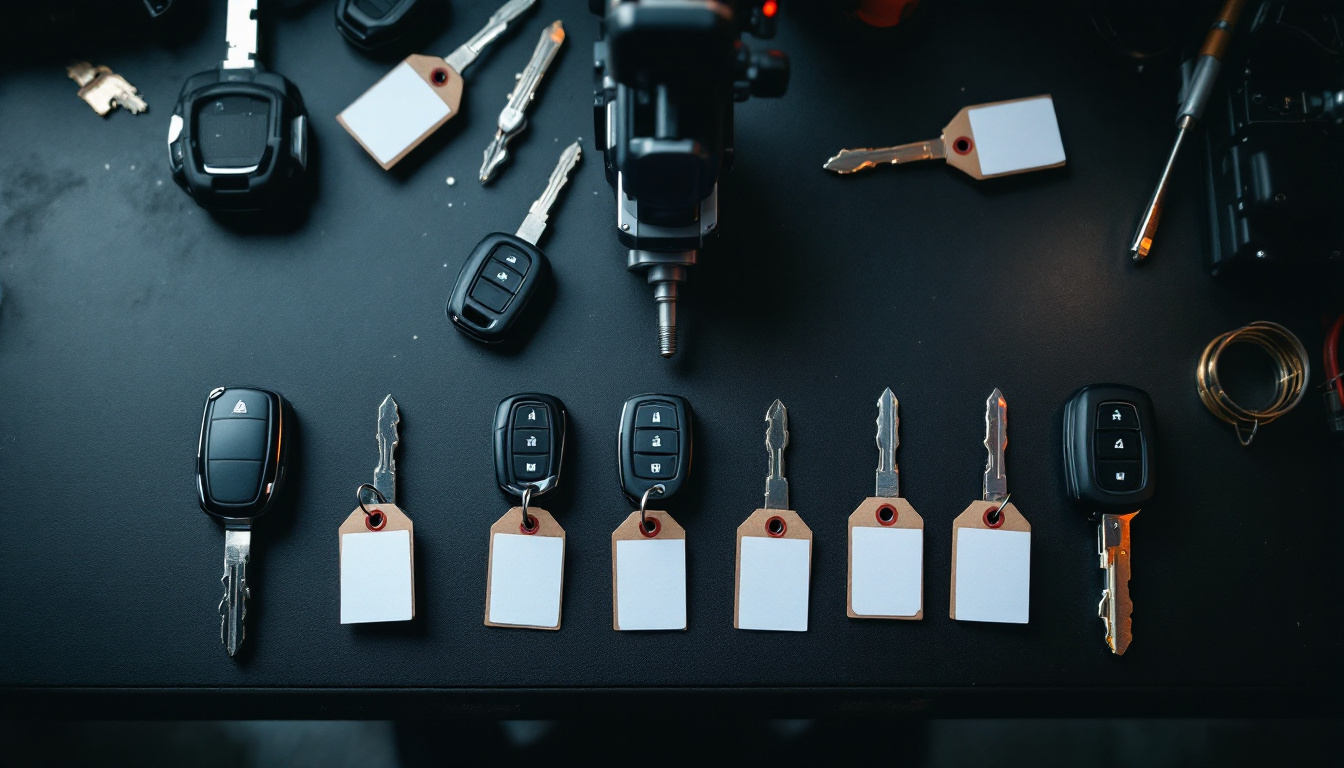
As of September 2026, putting a spare key on every vehicle in a Dallas–Fort Worth fleet costs $70–$180 per unit when the work is batched at your yard — $70–$180 for a mechanical or transponder key cut and programmed alongside its neighbours, and $250–$500 only where a unit runs proximity fobs. The number to compare it against is not zero. It is the $130–$500 a first key costs in an emergency, plus the tow, plus the day. Call (817) 813-8746 and we will price your list.
Quick Answer: What a Spare Key Programme Actually Is
It is a scheduled visit, not a service contract. A technician comes to the yard with a list of VINs, works down the row, and leaves with every unit carrying a documented second key. There is nothing to sign and nothing recurring.
The price is per unit, not per call-out. The first vehicle carries the trip. Everything after it is marginal — $70–$180 for the common key types — which is the entire reason this is done in a batch rather than one truck at a time.
Proximity fobs are the exception. Where a unit uses a push-button fob rather than a cut key, the hardware itself costs real money and the line is $250–$500. Most mixed fleets have a handful of these and dozens of the cheap kind.
The output is a labelled set, not a bag of keys. Keys leave marked to unit number rather than to VIN, because a key marked with a VIN is a theft aid and a key marked “Truck 14” is not.
The point is removing a failure mode. A fleet where every vehicle has one key has a standing daily risk of a total stop. A fleet with spares has an inconvenience instead.
What It Costs, Line by Line
These are our own first-party mobile ranges across the metroplex, quoted for batched work at one location on one visit.
| Key type on the unit | Per-unit cost in a batch | Same key bought alone, later |
|---|---|---|
| Mechanical key, no chip (older trucks, trailers, heavy units) | $70–$180 | $70–$180 plus a full trip charge |
| Transponder key, cut and programmed | $70–$180 | $130–$350 as a single job |
| Remote-head or flip key | $70–$180 | $130–$250 as a single job |
| Proximity fob, push-button start | $250–$500 | $250–$500 plus a full trip charge |
| First unit of the visit (carries the trip) | $130–$500 | — |
| Same unit with no key at all, in an emergency | — | $130–$500 plus tow and downtime |
Read the right-hand column carefully, because it is the whole argument. A transponder key that costs $70–$180 as the eleventh key of a morning costs $130–$350 as a standalone job six months later, and that is the good outcome — the bad one is the same key bought at 6am with the truck immobilised on a customer’s site. The per-visit arithmetic behind that is set out in our guide to fleet locksmith visit cost per truck in DFW, and the emergency version of the same line is in fleet key replacement cost in DFW. For the retail baseline a fleet is measuring itself against — what one key bought on its own actually costs in this market — see car key replacement cost in Fort Worth.
Start With an Audit, Because Most Fleets Guess Wrong
Ask a fleet manager how many vehicles have spares and the answer is usually a confident number that turns out to be optimistic by a wide margin. Three things cause the gap.
Keys leave with drivers. Turnover takes keys with it, quietly, and nobody reconciles the cabinet afterwards. What looks like a spare on the board is often a key that walked out of the building last spring.
The spare in the drawer does not work. It is a mechanical copy of a transponder key, or it was cut from a worn original and turns stiffly, or it belongs to a unit that has since had its ignition replaced on a different key. An untested spare is a hypothesis, not a spare.
Nobody knows which key is which. Unlabelled keys in a shared cabinet converge on uselessness. We regularly find drawers with more keys than vehicles and no way to match them up.
The audit is fifteen minutes of walking the yard with the list: for each unit, does a second key exist, does it physically start the vehicle, and is it labelled. Only the keys that fail one of those three tests go on the work order. On a typical first pass, a fleet that believed it had 60 per cent coverage discovers something closer to 25 per cent, and the ones it does have skew heavily toward vehicles nobody drives.
The Cost of Not Having One, Which Is the Real Comparison
A missing spare is not a $150 problem; it is a $150 problem that arrives at the worst possible moment, because it arrives when the first key has just failed.
The sequence is always the same. A key breaks, gets lost on a site, or goes home in a departed driver’s pocket. If a spare exists, somebody drives it out and the day continues. If it does not, the vehicle is stationary until a technician reaches it, and with no working key to copy the job becomes an all-keys-lost recovery rather than a duplication — a different and more expensive class of work, which we cover in all keys lost on a company vehicle in DFW.
The exposure compounds on vehicles carrying contents. A loaded van immobilised overnight is not only an idle asset, it is an attractive one, and vehicle theft remains a large-volume crime even after recent improvement: the National Insurance Crime Bureau recorded 850,708 vehicles stolen in the United States in 2024, down 17 per cent from 1,020,729 in 2023. Lockouts are similarly routine rather than exotic — the American Automobile Association rescues roughly four million locked-out drivers a year, and a fleet is simply a group of drivers with above-average exposure.
Mixed Fleets: the Expensive Handful and the Cheap Majority
Very few DFW fleets are uniform. A typical list has fifteen domestic pickups, four vans, two heavy units and one or two executive or customer-facing vehicles, and the per-unit price varies by an order of magnitude across that list.
The cheap majority are the work trucks. Transponder and remote-head keys are commodity work in a batch, which is why the domestic half of most fleets prices out at the bottom of the table. Model-by-model detail for the biggest of those families is in Chevy and GMC key replacement in DFW, and for the Toyota units that show up in service and utility fleets, in Toyota key replacement in Fort Worth.
The expensive handful are the European and executive vehicles. A single fob for a luxury sedan can cost more than three work-truck keys, which is exactly why those units are the ones most likely to still be running on one key — somebody looked at the price, flinched, and deferred. Black-car and executive operators hit this constantly; the pricing shape is in BMW key replacement in DFW, and for the Sprinter-based vans that sit in a lot of mixed fleets, in Mercedes key replacement cost in DFW.
The right way to handle a mixed list is not to price the whole fleet at the worst line. Batch the cheap majority now, because that is where nearly all the units and nearly all the daily risk are, and decide on the expensive handful separately with the numbers in front of you. For a straight external benchmark on what fobs cost through a dealer, the Kelley Blue Book survey of dealership fob pricing puts them at $150–$500 and up.
Real-World Example: Twenty-Two Units, Two Hours, One List
Situation. A landscaping company operating out of Grand Prairie had lost two days that quarter to key failures — once when a key snapped in a gate padlock and the same ring went into a storm drain, once when a seasonal driver simply stopped answering the phone. The office believed about half the fleet had spares.
What we did. Walked the list first. Of 22 units, seven had a spare that actually started the vehicle. Four more had a key in the cabinet that did not, and eleven had nothing. We cut and programmed spares for the fifteen units without a working one in a single morning, working down the row, and labelled everything to unit number rather than VIN. Two trucks turned out to have had ignitions replaced on different keys at some point, so those were brought back onto one key while we were there.
Result. Full coverage for a per-unit figure in the batched band rather than fifteen separate call-outs, and a key board that matches the yard. The seasonal-driver scenario that cost them a day in June is now a five-minute walk to the cabinet.
Every fleet we do this for finds fewer working spares than it expected, and the gap is always concentrated in the vehicles that run every day. The trucks parked at the back all have keys. — senior mobile technician, Metroplex Locksmith
Hiring This Out Properly in Texas
Handing a list of VINs and a yard gate to a vendor deserves the same diligence as any other supplier decision.
Texas locksmiths are licensed by the Department of Public Safety Private Security Program — never TDLR. Ask for the licence number. For late-model vehicles, ask whether the technician is registered with the National Automotive Service Task Force Vehicle Security Professional programme, which is the legitimate route to manufacturer security data; a vendor working outside it on modern units is a problem you do not want attached to your fleet.
Expect to prove the vehicles are yours. A serious locksmith will ask for registration or title in the company name and identification from whoever authorises the work, and will decline if it is not forthcoming. That is the control protecting your fleet from somebody else ordering keys to it, so treat a vendor who skips it as a warning rather than a convenience.
On price, the Federal Trade Commission’s guidance on locksmith bait-and-switch applies here too: a per-unit quote given against a VIN list should survive the visit. Professional conduct standards from the Associated Locksmiths of America describe the baseline, and the Bureau of Labor Statistics treats locksmiths and safe repairers as a distinct skilled occupation with a national average wage near $50,000 a year, which is the honest floor under a quote for a morning of skilled bench work.
What to Have Ready When You Call
A VIN list, not a vehicle count. Twenty VINs let us tell you the exact cost before anybody drives out. “About twenty trucks” only gets you a range, because key type varies by build inside the same model year.
The result of the walk-round. Which units have a spare that genuinely starts the vehicle. That single column decides the size of the job.
Where they will be, and when. Batching only works if the vehicles are in one place at one time. An hour before the crews roll out, or a Saturday morning, is usually easier than mid-shift.
How you want them labelled. Unit numbers, not VINs. If you have a numbering convention, tell us and the keys will arrive matching it.
We run spare key programmes at yards and depots from Dallas to Denton and across the metroplex. See key duplication and key fob programming for the service detail, car key replacement for the emergency version, or go straight to our contact page.
Frequently Asked Questions
How much does a spare key cost per vehicle if we do the whole fleet at once?
For the common key types — mechanical, transponder and remote-head — $70–$180 per unit once the first vehicle has carried the trip charge. Units running proximity fobs are $250–$500 because the hardware itself is expensive. Most mixed fleets are overwhelmingly the cheap kind with a small expensive handful.
Do you need to take the vehicles anywhere?
No. This is mobile work done at your yard, depot or job site, which is what makes batching worthwhile in the first place. The vehicles need to be present and accessible during the visit, but nothing has to be driven to a shop and nothing sits in a service queue overnight.
We have keys in a drawer already. Is that coverage?
Only if each one has been tested in the vehicle it belongs to. In practice a large share of cabinet keys turn out to be mechanical copies of transponder keys, worn copies that no longer turn cleanly, or keys to a unit whose ignition has since been replaced. An untested spare is a hypothesis, and the audit that tests them takes about fifteen minutes.
Should keys be labelled with the VIN so we can match them later?
No. A key tagged with a VIN tells anybody who finds it exactly which vehicle it opens, which is a theft aid rather than an organising system. Label to unit number and keep the unit-to-VIN mapping in your own records, where it is useful to you and useless to somebody who picks up a lost key.
Is it cheaper to buy a blank online and have it programmed?
Rarely, and it introduces a failure mode. Aftermarket blanks vary in quality and chip compatibility, and a key that will not take a programme wastes the visit it was meant to save money on. Where a customer-supplied key is genuinely suitable we will use it, but the saving is usually smaller than the risk of a truck without a spare for another month.
How often should a fleet re-run this?
Annually is reasonable for a stable fleet, and after any period of heavy turnover regardless of the calendar, because departing drivers are the main way coverage silently erodes. New units should get their spare when they enter service rather than when the original key first goes missing.
The Bottom Line
A spare key programme is the cheapest insurance a fleet can buy, and it is cheap for a structural reason: the marginal key in a batch costs a fraction of the same key bought alone in an emergency. The trucks that matter most — the ones running every day — are the ones most likely to be missing a spare, because those are the keys that get lost.
Start with the walk-round. If fewer than three-quarters of your units have a spare that genuinely starts the vehicle, you have a standing daily risk that costs less to remove than one bad morning. Call (817) 813-8746 with the VIN list, or use our contact page.